
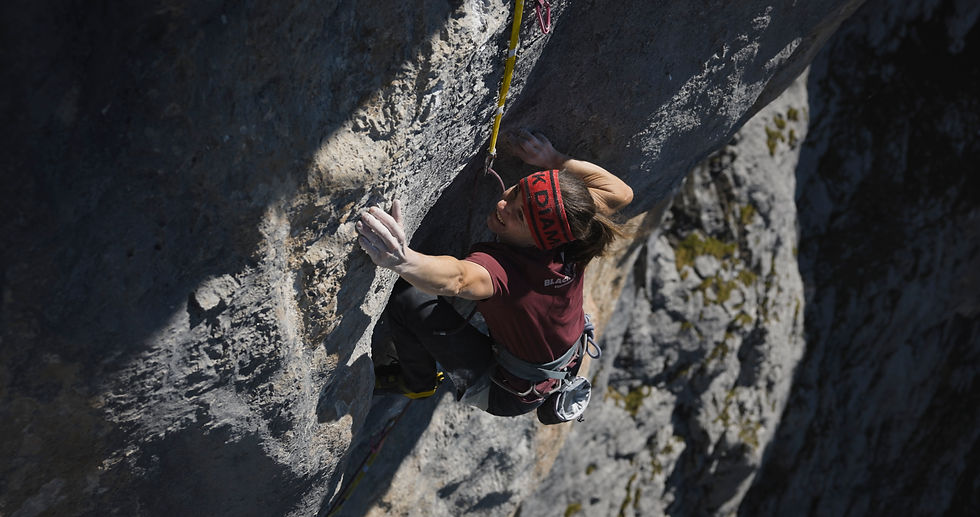
Babsi Zangerl réalise la première féminine de WoGü (8c)

Les 22 et 23 août 2026, Jacopo Larcher et Babsi Zangerl ont libéré WoGü (8c), grande voie mythique du Rätikon, à un jour d’intervalle. Après un mois de travail, les deux grimpeurs ont réussi dès leur première tentative depuis le bas. L’Autrichienne réalise au passage la première ascension féminine de la voie.
Neuf longueurs, 270 mètres d’escalade et un itinéraire engagé ouvert par Beat Kammerlander à la fin des années 1990 : WoGü fait partie des grandes voies les plus emblématiques et difficiles des Alpes. Située sur la septième Kirchlispitze, dans le Rätikon suisse, elle n’avait jusqu’ici été libérée que par une poignée de grimpeurs.
Les 22 et 23 août 2026, deux nouveaux noms se sont ajoutés à cette liste particulièrement courte. Jacopo Larcher a d’abord réussi la voie, avant que Babsi Zangerl la fasse dès le lendemain. Tous deux ont enchaîné WoGü lors de leur première tentative complète après plusieurs séances de travail réparties sur un mois.
Au-delà de ce doublé réalisé en deux jours, l’ascension de Babsi Zangerl marque une étape historique : elle devient la première femme à libérer l’intégralité de WoGü.

Un projet commencé presque spontanément
Le couple venait déjà de conclure un autre projet majeur dans le Rätikon avec l’ascension de Déjà, une grande voie encore plus difficile sur le papier. Leur matériel se trouvait toujours au pied de la paroi et WoGü, située seulement une cinquantaine de mètres plus loin, faisait partie des lignes qu’ils rêvaient de découvrir depuis plusieurs années.
« Nous voulions aller voir cette voie depuis longtemps. Nous avions énormément de respect pour elle et pour son histoire. Elle était devenue légendaire à nos yeux et la grimper représentait un petit rêve. »
Les images de Beat Kammerlander lors de son ouverture depuis le bas, puis celles d’Adam Ondra pendant la première ascension en libre, réalisée en 2008 alors qu’il n’avait que 15 ans, ont largement participé à construire la réputation de WoGü.
Si sa difficulté maximale est inférieure à celle de Déjà, la voie se montre particulièrement soutenue. Elle enchaîne les passages techniques et les sections typées bloc, sur un calcaire exigeant et avec des points parfois très espacés.
« C’est une voie de Beat Kammerlander, alors il faut s’attendre à de grandes distances entre les points. Arriver du bas jusqu’au sommet pour la première fois n’est probablement jamais simple. Mais c’est aussi ce qui rend ces voies aussi attirantes : elles restent toujours une aventure. »
Neuf longueurs et presque aucune marge d’erreur
Larcher et Zangerl ont commencé à travailler WoGü durant la dernière semaine de juillet. Ils sont rapidement parvenus à réaliser séparément toutes les longueurs, mais l’enjeu principal était ailleurs : parvenir à les enchaîner au cours d’une même journée.
Le couple a passé plusieurs soirées dans la paroi, la chaleur estivale rendant l’escalade difficile plus tôt dans la journée. Après être arrivés dans le Rätikon en fin d’après-midi, ils terminaient régulièrement leurs séances à la frontale. Certaines sections, particulièrement abrasives, les empêchaient également de grimper deux jours consécutifs.
La première longueur cotée 8c développe environ 45 mètres. Elle commence par une longue section autour du 8a, ponctuée de quelques repos et d’un passage engagé, avant un mouvement de bloc difficile situé juste sous le relais. Une chute à cet endroit impose de recommencer l’ensemble de la longueur.
La différence de taille entre les deux grimpeurs les a obligés à utiliser des méthodes différentes. Larcher a rapidement trouvé une solution correspondant à son allonge, tandis que Zangerl a dû consacrer davantage de temps à la recherche d’une méthode adaptée.
Des 8b+ courts, techniques et engagés
La difficulté de WoGü ne repose pas uniquement sur sa longueur en 8c. L’une des sections qui a demandé le plus de travail au couple est une longueur très courte en 8b+, haute d’environ douze mètres. Verticale, voire légèrement en dalle par endroits, elle se déroule sur de minuscules prises de mains et de pieds. La précision y est essentielle : le moindre déséquilibre peut provoquer la chute.
La longueur suivante, surnommée Badewanne, constitue un autre morceau particulièrement redouté. La présence d’une dalle sous le grimpeur rend la chute impressionnante.
Après un petit repos, la longueur se poursuit sur des réglettes extrêmement tranchante. Pour Jacopo Larcher, cette section et le court 8b+ précédent représentaient les deux plus grandes difficultés de l’itinéraire.
Un second 8b+, plus raide et plus proche de l’escalade sportive, propose ensuite trois passages difficiles séparés par de bons repos. Les deux dernières longueurs sont plus abordables sur le papier, mais restent exigeantes, notamment lorsque la partie supérieure de la voie est humide.

Jacopo Larcher ouvre la voie sous la menace de la pluie
Exactement un mois après leur première séance dans WoGü, les deux grimpeurs se sont estimés prêts à tenter l’enchaînement complet. Leur objectif était clair : chacun devait grimper toutes les longueurs en tête. L’un réaliserait sa tentative tandis que l’autre l’assurerait, avant d’échanger les rôles le lendemain. Babsi Zangerl avait été la première à tenter Déjà. Cette fois, Jacopo Larcher s’est donc lancé en premier.
Les conditions ont pourtant failli repousser leur projet. Après une nuit pluvieuse, la paroi était entièrement trempée au réveil. Le couple a attendu jusqu’à midi dans son van sans réellement croire à une tentative possible, avant de voir progressivement le rocher sécher.
Larcher a commencé prudemment, puis a retrouvé de la confiance au fil des longueurs. Il a franchi le premier 8c dès son premier essai de la journée, économisant ainsi une énergie précieuse pour la suite.
Il est ensuite tombé dans le court 8b+ après avoir perdu l’équilibre. Quelques minutes de repos et une nouvelle révision de la méthode lui ont suffi pour réussir la longueur lors de sa tentative suivante.
Badewanne lui a également demandé un essai supplémentaire. Après une erreur dans le début de la longueur, qui l’a conduit à saisir une dégaine, l’Italien est reparti presque immédiatement et a atteint le relais malgré une nouvelle alerte dans le crux supérieur.
Les longueurs suivantes se sont déroulées sans chute. La dernière, pourtant l’une des moins difficiles de la voie, lui a réservé un ultime combat en raison de prises encore humides.
« Nous n’étions même pas certains de pouvoir grimper avant midi et, quelques heures plus tard, je me retrouvais au sommet de l’une des grandes voies les plus emblématiques des Alpes. »
Babsi Zangerl réalise la première ascension féminine
Après une courte nuit, le couple est revenu au pied de la paroi pour la tentative de Babsi Zangerl. La météo était plus favorable, mais la hausse annoncée des températures a poussé l’Autrichienne à partir très tôt afin d’atteindre les longueurs les plus difficiles avant leur passage au soleil.
La première dalle en 7a était encore complètement mouillée. Une difficulté loin d’être anodine sur un terrain technique et parfois engagé. Zangerl est néanmoins parvenue à franchir cette première étape avant de poursuivre sur une paroi globalement sèche.
Dans le 8c, elle devait réaliser une méthode différente de celle de Larcher, avec un dernier mouvement jugé particulièrement aléatoire. Elle a atteint la dernière prise au terme d’un jeté engagé et a ainsi évité de devoir recommencer les 45 mètres de la longueur.
Elle a ensuite réussi dès son premier essai du jour le court 8b+ qui l’inquiétait le plus. Les prises coupantes et la chaleur déjà présente auraient pu rendre les tentatives supplémentaires particulièrement coûteuses pour la peau.
Badewanne est également passée dès le premier essai malgré une erreur de méthode qui l’a obligée à improviser. Même réussite dans le dernier 8b+, puis dans le 8a+ et les longueurs finales.
Babsi Zangerl a ainsi atteint le sommet de WoGü sans chuter au cours de cette première tentative complète. Une journée après Larcher, elle devenait la première grimpeuse à libérer l’intégralité de la voie.
« Nous savions que nous pouvions y arriver, mais nous ne pensions pas réussir tous les deux à un jour d’intervalle et dès notre première véritable tentative d’enchaînement. »
Une voie libérée par seulement sept grimpeurs
Avant l'enchaînement de Jacopo Larcher et Babsi Zangerl, seuls cinq grimpeurs avaient réalisé une ascension documentée de WoGü en libre.
Adam Ondra avait signé la première libération en 2008, à seulement 15 ans. Edu Marín l’avait ensuite répétée en 2016, suivi par Roland Hemetzberger en 2017, Cédric Lachat en 2020 et Louna Ladevant en 2023.
Pour le couple, ce doublé conclut un été particulièrement dense dans le Rätikon. Malgré leurs nombreuses expériences dans le massif, son calcaire technique, ses mouvements précis et l’engagement de ses voies continuent de leur imposer une période d’adaptation. WoGü aura finalement été la conclusion idéale.
« Quel week-end parfait et quelle manière idéale de terminer notre saison dans le Rätikon. Immense respect à Beat pour avoir ouvert une telle ligne à cette époque. Tu es une légende et une grande source d’inspiration. »
Babsi Zangerl Claims the First woman Ascent of WoGü (8c)
On August 22 and 23, 2026, Jacopo Larcher and Babsi Zangerl made back-to-back free ascents of WoGü (8c), one of the Rätikon’s most iconic multipitch routes. After working the line for a month, both climbers succeeded on their first complete redpoint attempts. Zangerl’s ascent also marked the first female free ascent of the route.
Nine pitches, 270 metres of climbing and a demanding line established by Beat Kammerlander in the late 1990s: WoGü is widely regarded as one of the most iconic and difficult multipitch routes in the Alps. Located on the seventh Kirchlispitze in Switzerland’s Rätikon range, it had previously been free climbed by only a handful of climbers.
On August 22 and 23, 2026, two more names were added to that short list. Jacopo Larcher completed the route first, before Babsi Zangerl followed just one day later. After several sessions spread over a month, both succeeded on their first full redpoint attempts.
Beyond completing the route on consecutive days, Zangerl achieved an additional milestone by becoming the first woman to free climb WoGü in its entirety.
A Project That Began Almost Spontaneously
The pair had already completed another major project in the Rätikon with their ascents of Déjà, a multipitch route that is even more difficult on paper. Their equipment was still stored beneath the wall and WoGü, located only around 50 metres to the right, was a line they had wanted to try for several years.
“We had wanted to check it out for years. At the same time, we had huge respect for it, knowing its history. For us, it was one of those routes that had become legendary and would have been a little dream to climb.”
The iconic images of Beat Kammerlander during his ground-up ascent, followed by photographs of a 15-year-old Adam Ondra making the first free ascent in 2008, helped establish WoGü’s legendary reputation.
Although its maximum grade is lower than that of Déjà, WoGü is considerably more sustained. It combines technical climbing with several hard, bouldery sections on demanding limestone, while some sections feature significant distances between the protection points.
“It’s a Beat Kammerlander route, which means you can expect some big runouts. Getting from the bottom to the top for the first time probably isn’t going to be easy. But that is also what makes these routes so appealing to us. They are always an adventure.”
Nine Pitches With Almost No Room for Error
Larcher and Zangerl began working on WoGü during the final week of July. They quickly managed to climb each pitch individually, but the main challenge was to link every pitch within a single day.
The pair spent several evenings on the wall, as the summer heat made climbing difficult earlier in the day. They would arrive in the Rätikon during the late afternoon and regularly finish their sessions by headlamp. Some sections were also extremely sharp and abrasive, meaning they were rarely able to climb on two consecutive days.
The first 8c pitch is approximately 45 metres long. It begins with an extended section around 8a, featuring a few rests and a substantial runout, before ending with a difficult boulder problem immediately below the anchor. Falling at this point requires the climber to repeat the entire first section.
The difference in height between the two climbers meant they had to use different beta. Larcher quickly found a sequence that suited his reach, while Zangerl needed more time to discover an alternative method.
Short, Technical and Runout 8b+ Pitches
The difficulty of WoGü does not rest solely on its 8c pitch. One of the sections requiring the most work was a very short 8b+ pitch measuring approximately 12 metres.
Vertical and, in places, slightly less than vertical, it follows extremely small handholds and footholds. Precision is essential, as even the slightest mistake or loss of balance can result in a fall.
The following pitch, known as Badewanne, presented another significant challenge. Its opening section is difficult to read and cannot simply be climbed by pulling from one bolt to the next. A slab beneath the climber also makes falling feel particularly uncomfortable.
After a small rest, the pitch continues through a crimpy section on extremely sharp holds. For Larcher, Badewanne and the short 8b+ below it were the two most challenging sections of the entire route.
Another 8b+ follows higher on the wall. Steeper and more similar to sport climbing, it features three difficult sections separated by very good rests, although the protection remains widely spaced.
The final two pitches are easier on paper, but they still require concentration, especially when the upper section of the last pitch is wet.
Jacopo Larcher Sets Off After the Rain
Exactly one month after their first session on WoGü, the two climbers felt ready to attempt the complete route.
Their objective was clear: both wanted to lead every pitch. One would climb while the other belayed, before switching roles the following day. As Babsi Zangerl had gone first on Déjà, it was Larcher’s turn to make the first attempt.
The weather almost forced them to postpone their plans. After heavy rain during the night, the wall was completely soaked the following morning. The pair waited in their van until midday and did not believe climbing would be possible. When the rock began to dry, however, they decided to hike to the base of the route.
Larcher started cautiously but became increasingly confident as he progressed. He completed the first 8c pitch on his first attempt of the day, saving valuable energy for the remaining difficulties.
He then fell on the short 8b+ after losing his balance. The pitch was sufficiently short and technical that he did not need much time to recover. After reviewing the sequence and resting for a few minutes, he set off again and reached the anchor.
Badewanne also required a second attempt. Larcher made a mistake in the opening section and grabbed a quickdraw. After another short rest, he started again and completed the pitch, despite nearly falling at the upper crux.
The following pitches went smoothly, allowing him to reach the final section quickly. Although it is one of the easiest pitches on paper, its upper part was still wet and forced him to fight until the very end.
“We weren’t even sure we would climb until noon, and a few hours later I was standing on top after climbing one of the most iconic multipitches in the Alps.”
Babsi Zangerl Makes the First Female Ascent
Following a short night, the pair returned to the base of the wall for Babsi Zangerl’s attempt. The weather forecast was more favourable, but rising temperatures encouraged the Austrian climber to start very early so that she could reach the most difficult pitches while they were still in the shade.
The first 7a slab was still completely wet. This was far from straightforward on technical and occasionally runout terrain. Zangerl nevertheless fought her way through this difficult opening pitch, while the rest of the wall appeared largely dry.
On the 8c pitch, she had to use a different sequence from Larcher. The final move was particularly low-percentage and she was determined not to repeat the entire 45-metre pitch. Climbing confidently, she reached the final section and committed to a throw for the last hold, successfully completing the pitch on her first attempt of the day.
She then reached the short 8b+ that had worried her the most. The insecure climbing, sharp holds and increasing heat meant additional attempts could have been particularly costly for her skin. Nevertheless, everything went smoothly and she completed it first go.
Badewanne followed. After making a mistake in her planned sequence, Zangerl was forced to improvise, but she still completed the pitch on her first attempt.
She also climbed the final 8b+ first go, despite being concerned about a long move in the middle of the pitch. The following 8a+ felt more difficult than expected, but she completed it without falling, along with the final pitch.
Zangerl therefore reached the top of WoGü without falling during her first complete redpoint attempt. One day after Larcher, she became the first woman to free climb the entire route.
“We knew we could do it, but we didn’t expect to both climb it back-to-back and on our first full redpoint attempts.”
A Route Free Climbed by Only Seven Climbers
Before the ascents of Jacopo Larcher and Babsi Zangerl, only five climbers had completed documented free ascents of WoGü.
Adam Ondra made the first free ascent in 2008, when he was only 15 years old. Edu Marín repeated the route in 2016, followed by Roland Hemetzberger in 2017, Cédric Lachat in 2020 and Louna Ladevant in 2023.
Zangerl’s achievement should not be described as the first female ascent of an 8c multipitch pitch, but more precisely as the first female free ascent of WoGü in its entirety.
For the pair, the back-to-back ascents brought an intense summer in the Rätikon to a fitting conclusion. Despite spending many years climbing in the range, its technical movement, uncompromising limestone and often serious protection continue to demand a period of adaptation.
WoGü ultimately provided an ideal conclusion to their season: a route steeped in climbing history, demanding enough to require a month of preparation and finally completed together on consecutive days on the seventh Kirchlispitze.
“What a perfect weekend and the perfect way to end our Rätikon season for this year. Huge respect to Beat for putting up such a line back in the day. You’re a legend and a big inspiration.”

✍️ Théo – GrimpActu


Commentaires